

Zone 2 Training for Beginners: The Secret to Fat Loss and Infinite Energy
Introduction
Discovering Zone 2 training for beginners usually happens after years of “Go Hard or Go Home” workouts that leave you exhausted, injured, and strangely… not losing weight. I spent my 20s thinking that if I wasn’t gasping for air and sweating puddles, the workout didn’t count. I ran fast, I did HIIT classes, and I burned out.
Then, I learned about Zone 2. It is the training method used by Tour de France cyclists and elite marathon runners, yet it is shockingly easy. It feels “too slow.” But this slow burn is where the magic happens. It teaches your body to burn fat instead of sugar. It builds a metabolic engine that allows you to have energy all day long. According to Dr. Peter Attia, a leading longevity expert, Zone 2 is the foundation of a long healthspan.
In this comprehensive 1200-word deep dive, I will explain the science of Mitochondria, how to use the “Talk Test” to find your zone without a heart rate monitor, and why slowing down is actually the fastest way to get fit.
1. The Science: Mitochondria and Metabolic Flexibility
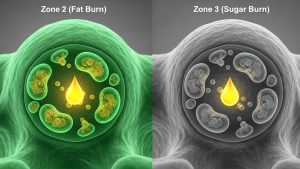
To understand Zone 2, you have to look inside your cells. You have little power plants called Mitochondria. They turn fuel into energy (ATP).
-
Zone 2 (Low Intensity): Your body uses Oxygen to burn FAT for fuel. This happens in the mitochondria.
-
Zone 3/4/5 (High Intensity): Your body needs energy faster than oxygen can be delivered. It switches to burning GLUCOSE (Sugar). This creates lactic acid.
Most people spend their gym time in “Zone 3” (The Grey Zone). It is too hard to build mitochondria efficiently, but too easy to build peak speed. It is “junk mileage.” Zone 2 training for beginners focuses on staying in that low-intensity sweet spot where you are maximizing fat oxidation and building more/bigger mitochondria.
2. Finding Your Zone: The “Talk Test”
You don’t need a $500 Garmin watch or a chest strap to start (though they help). You can use the Talk Test. Zone 2 is the highest level of exertion where you can still hold a conversation, but you sound a little breathless.
The Test: Go for a jog or a brisk walk. Try to say a full sentence: “I am going to the store to buy some milk and eggs.”
-
If you can say it easily: You are in Zone 1 (Too easy).
-
If you can say it, but need to take a breath halfway: You are in Zone 2 (Perfect).
-
If you can only say 3 words at a time: You are in Zone 3 or 4 (Too hard). Slow down.
It requires ego death. You might have to walk on hills. You might run slower than a grandma. That is okay. You are building the engine, not testing the speed.

3. The Fat Burning Miracle
Why is this best for weight loss? When you do high-intensity cardio (HIIT), you burn a lot of calories, but a high percentage comes from glycogen (stored carbs). Afterwards, your body screams for sugar to replace that glycogen. You get “runger” (running hunger) and eat a donut. In Zone 2, you are primarily burning body fat. Because you didn’t deplete your sugar stores, you don’t get those intense carb cravings afterward. According to a study published in Sports Medicine, low-intensity steady-state training is superior for improving fat oxidation rates in sedentary individuals.
4. The 80/20 Rule: Polarized Training
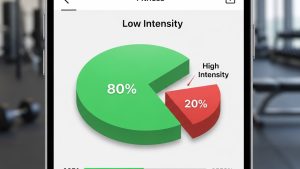
You don’t have to quit sprinting forever. Elite athletes follow the 80/20 Rule.
-
80% of the time: Zone 2 (Easy, boring, long).
-
20% of the time: Zone 5 (Max effort, vomiting intensity).
This “Polarized Training” keeps you fresh. The Zone 2 builds the base so you can recover faster; the Zone 5 builds the peak performance. For a beginner, this might look like:
-
Mon/Wed/Fri: 45 mins Zone 2 walk/jog.
-
Sat: 15 mins intense intervals.
5. How to Do It Indoors: The Treadmill Desk
Zone 2 takes time. You need 45-60 minutes to get the full mitochondrial benefit. Who has an hour a day? Multitasking is the key.
-
Incline Walking: Set a treadmill to 10-12% incline and walk at 3 mph. This gets your heart rate up without the impact of running.
-
Cycling: A stationary bike is perfect because you can watch Netflix or answer emails while pedaling.
-
Rucking: Put 20 lbs of books in a backpack and go for a walk. The added weight pushes your heart rate into Zone 2 without you having to run.
6. Patience: The Hardest Part
The first month of Zone 2 training for beginners is frustrating. You will feel like you are moving in slow motion. Your pace will be embarrassing. You will want to speed up. Don’t. If you speed up into Zone 3, you stop the specific fat-burning adaptation. You are back to burning sugar. Trust the process. After about 3 months, a magical thing happens: Your “Zone 2 Speed” increases. You will be running faster at the same low heart rate. This is efficiency. This is fitness.
7. Heart Rate Math (If You Have a Watch)
If you love data, you can use the Maffetone Method (180 Formula) as a rough estimate.
-
Formula: 180 minus your Age = Your Upper Zone 2 Limit.
-
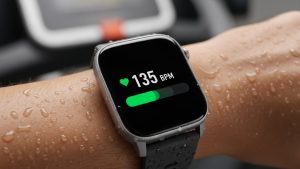
Example: If you are 40 years old: 180 – 40 = 140 BPM.
-
Keep your heart rate between 130 and 140 BPM.
Note: This is generic. The Talk Test is often more accurate for individuals, but the numbers give you a guardrail.
Frequently Asked Questions (FAQs)
Q: Can I lift weights in Zone 2? A: No. Weightlifting is anaerobic (without oxygen). It spikes your heart rate and uses sugar. Do your lifting separately, or do it after your Zone 2 cardio.
Q: Is walking Zone 2? A: For most fit people, walking is Zone 1 (too easy). You need to walk fast, walk uphill, or carry weight (Rucking) to get into Zone 2. If you can sing a song, walk harder.
Q: How many times a week? A: Aim for 3 to 4 sessions of 45 minutes minimum. The metabolic magic starts happening after the 30-minute mark.
Q: Can I split it up (15 mins morning, 15 mins night)? A: Better than nothing, but continuous is better. The mitochondria need sustained stress to adapt.
Conclusion
Adopting Zone 2 training for beginners is the smartest investment you can make for your future health. It prevents burnout, melts fat, and builds a heart that can go forever. It forces you to check your ego at the door and listen to your body’s physiology. So put on your shoes, slow down, and enjoy the ride. You aren’t being lazy; you are being scientifically efficient.