Leash Reactivity Training: How to Stop Your Dog from Barking at Everything
Introduction
Starting leash reactivity training usually begins after a humiliating experience. I will never forget the morning I took my rescue dog, Luna, for a peaceful walk. We turned a corner, and she saw a Golden Retriever across the street. Instantly, my sweet, cuddly dog transformed into a snarling, barking beast, lunging at the end of the leash like “Cujo.” The other owner looked at me with fear and judgment. I dragged Luna away, apologizing profusely, feeling like a complete failure as a pet parent.
If this sounds familiar, you are not alone. This behavior is called “Leash Reactivity,” and it is one of the most common reasons owners seek professional help. It is often mistaken for aggression, but according to the American Kennel Club (AKC), it is usually rooted in fear or frustration, not dominance. In this comprehensive 1200-word deep dive, I will explain the psychology of the “Threshold,” why tightening the leash makes it worse, and the exact step-by-step leash reactivity training games you can play to turn your reactive dog into a calm walking companion.
1. The Science: It’s Not Aggression, It’s Fear
To fix the problem, you must understand it. When a dog is on a leash, they lose their primary defense mechanism: Flight. If they see a threat (another dog, a skateboarder), they cannot run away. So, their brain switches to Fight. They bark and lunge to say, “Go away! I am scary!” This is a panic attack, not a dominance display.
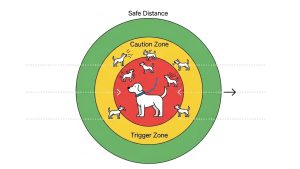
The “Threshold” Concept: Imagine a bubble around your dog.
-
Green Zone: The trigger (other dog) is far away. Your dog sees it but can still eat treats and look at you. (This is “Under Threshold”).
-
Red Zone: The trigger is too close. Your dog is barking, lunging, and won’t eat treats. (This is “Over Threshold”).
Training can only happen in the Green Zone. If your dog is already barking, you have lost. You need to increase distance immediately.
2. The Equipment: Harness vs. Collar
Using the wrong gear can make reactivity worse. If you use a standard collar or a choke chain, when your dog lunges, they choke themselves. This pain confirms their suspicion: “See? That other dog is dangerous! When I see him, my neck hurts!”
The Solution: Switch to a Front-Clip Harness (like the Freedom Harness or Easy Walk). When the dog pulls or lunges, the front attachment physically turns their body around to face you, breaking their fixation on the trigger without causing pain. According to the Certification Council for Professional Dog Trainers (CCPDT), avoiding aversive equipment prevents increasing the dog’s anxiety levels.
3. The Game: “Look at That” (LAT)
This is the core exercise of leash reactivity training. We want to rewire the dog’s brain from “Other Dog = Threat” to “Other Dog = Treat.”
The Steps:
-
Find a distance where your dog can see a trigger but isn’t barking (Green Zone).
-
Wait for your dog to look at the trigger.
-
The second they look, click your clicker (or say “Yes!”) and give them a high-value treat (chicken, cheese).
-
Repeat. Look -> Click -> Treat.
Eventually, the dog will see a trigger and immediately look at you, expecting a treat. You have changed the emotional response. This is called Counter-Conditioning.

4. The Emergency U-Turn: What to Do When You Fail
You will make mistakes. You will turn a corner, and a dog will be right there. Your dog will explode. Do not yell “No!” or yank the leash. You need an escape button.
Train the “Let’s Go!” U-Turn:
-
In your living room (no distractions), say “Let’s Go!” in a happy voice.
-
Turn 180 degrees and run the other way.
-
When your dog catches up, throw a party with treats.
-
Practice this on walks when no one is around.
When the real emergency happens, use this cue. Your muscle memory (and your dog’s) will kick in, and you will peel away from the situation quickly and happily, rather than having a tug-of-war.

5. Management: The “Visual Barrier” Hack
Sometimes, you can’t run away. You are stuck in a narrow hallway or between parked cars. You need to break the visual lock. The “Find It” Game: Throw a handful of treats on the ground directly in front of your dog’s nose. Say “Find It!” Your dog will look down to sniff and eat. Sniffing is a calming signal for dogs. While their nose is on the ground, the other dog passes by without eye contact occurring. You have successfully managed the situation.

6. Trigger Stacking: The Stress Bucket
Why does your dog ignore a squirrel on Monday but scream at it on Tuesday? This is Trigger Stacking. Imagine your dog has a stress bucket.
-
Morning: Mailman knocks (Bucket fills 10%).
-
Afternoon: Thunderstorm (Bucket fills 40%).
-
Evening Walk: Sees a squirrel (Bucket overflows).
If your dog has had a stressful day, skip the walk. Play brain games inside instead. Walking a stressed dog sets you up for failure because their cortisol is already high.
7. Diet and Exercise: The Foundation
A tired dog is a good dog, but an exhausted dog is cranky. You need the right balance.
-
Decompression Walks: Once a week, drive to a quiet field or empty trail. Put your dog on a 30-foot long line. Let them sniff everything. Sniffing lowers their pulse and cortisol.
-
Diet: Check the protein levels. Some studies suggest super-high protein diets (above 30%) can increase alertness/reactivity in some dogs. Consult your vet about a balanced diet suitable for their energy level.
Frequently Asked Questions (FAQs)
Q: Can I use a vibrating collar? A: I advise against it. Even a vibration can startle a fearful dog, adding more “scary” stimuli to the scary situation. We want to build confidence, not suppress behavior through fear.
Q: How long does this take to fix? A: Reactivity is rarely “cured,” but it is managed. With consistent leash reactivity training, you can see massive improvement in 3-6 months. My dog went from reacting at 50 feet to being calm at 5 feet over a year.
Q: My dog doesn’t want treats outside. Why? A: They are over threshold. If a dog won’t eat steak, they are terrified. You are too close to the trigger. Move further away until they will eat.
Q: Should I let them “meet” other dogs to get over it? A: NO. Never let a reactive dog greet other dogs on leash. The tension of the leashes forces a head-on greeting, which is rude in dog language and often leads to a fight. Keep them separated.
Conclusion
Committing to leash reactivity training is a lifestyle change. It requires you to be your dog’s advocate. It means crossing the street to avoid a trigger. It means telling strangers, “No, you can’t pet him, he is in training.” It is hard work, but the bond you build is unbreakable. You are telling your dog, “I see you are scared, and I will handle it.” Once they trust you to keep them safe, the barking stops, and the peaceful walks begin.