

The KonMari Method Checklist for Beginners: How to Declutter Your Home Once and For All
Introduction
Starting the KonMari method checklist is often less about cleaning your house and more about cleaning your mind. I remember the exact moment I decided enough was enough. I opened my “junk drawer” to find a battery, and instead, I found three broken charging cables, a menu for a pizza place that closed five years ago, and a wave of anxiety that ruined my morning. My home wasn’t a sanctuary; it was a storage unit for my procrastination.
We live in a culture of accumulation. We buy things to solve problems, only to find that the things themselves become the problem. Enter Marie Kondo, a diminutive Japanese organizing consultant who revolutionized the world with a simple question: “Does it spark joy?” It sounds simple, almost too simple. But the psychology behind it is profound. It shifts the focus from what you want to get rid of to what you want to keep.
In this comprehensive 1200-word deep dive, I will walk you through the five specific categories of the KonMari method, explain the physics of the “Vertical Fold,” and provide you with a step-by-step KonMari method checklist to transform your chaotic home into a minimalist haven.
1. The Philosophy: Tying Your Stuff to Your Emotions
Most cleaning methods fail because they focus on rooms (e.g., “Today I will clean the bedroom”). The KonMari method focuses on Categories. If you clean your bedroom closet today, but you have coats in the hall closet and winter gear in the attic, you never grasp the sheer volume of clothes you own. You just shuffle them around.
The “Spark Joy” Test: You must physically touch every single item you own. Pick it up. Hold it. Does it give you a little thrill? A feeling of lightness? That is “Sparking Joy.” If it gives you a heavy feeling of guilt (“I spent so much money on this”) or indifference, it has to go. Thank it for its service (yes, talk to the item), and let it go. This ritual helps release the guilt associated with waste, a concept supported by psychologists at Psychology Today who link clutter to elevated cortisol levels.
2. Category 1: Clothing (The Mountain)
You must start with clothes. They are the easiest to replace and have the least emotional baggage compared to photos.
The Process:
-
Take every single piece of clothing you own from every closet, drawer, and laundry basket.
-
Pile them on your bed.
-
The Shock Factor: Seeing that mountain of fabric is crucial. You will likely be horrified. “I didn’t know I had this much.” This shock breaks your attachment to “stuff.”
Sort through the pile. Keep only what fits you now and makes you feel confident. The “someday” jeans that haven’t fit in 5 years? Thank them and donate them. They are just reminders of a past version of yourself, not the current you.

3. The Art of Vertical Folding
Once you have decided what to keep, you must respect it. Do not stack your t-shirts like pancakes. The bottom shirt gets crushed, wrinkled, and forgotten. The Vertical Fold: Fold your clothes into a small, smooth rectangle that can stand up on its own. Store them in drawers standing up (like files in a filing cabinet).
-
Visibility: You can see every single shirt at a glance.
-
Space: It saves about 30-40% of drawer space compared to stacking.
-
Respect: It keeps the fabric happy.
I switched to vertical folding three years ago, and my drawers still look like a boutique display. It is the only system that doesn’t devolve into chaos after laundry day.

4. Category 2 & 3: Books and Papers
Books: Take them all off the shelves. Put them on the floor. Do not open them (or you will start reading and stop cleaning). Touch the cover. Does it spark joy?
-
The “Unread” Trap: We keep unread books because we want to be the kind of person who reads them. If it has sat there for 5 years, let it go. Pass it to a friend who will actually read it.
Papers: This is the most tedious part of the KonMari method checklist. Rule of Thumb: Throw away almost everything. We hold onto manuals for appliances we broke years ago and bank statements that are available online. Create three folders:
-
Pending: Needs action (bills).
-
Important (Permanent): Birth certificates, deeds, contracts.
-
Miscellaneous: Recipes, frequent references. Shred the rest. The mental clarity of an empty desk is unmatched.
5. Category 4: Komono (Miscellany)
“Komono” is Japanese for “small things.” This is everything else: Kitchen, Garage, Bathroom, Electronics. This category is huge, so break it down into sub-categories (e.g., Spices, Cords, Skin Care).
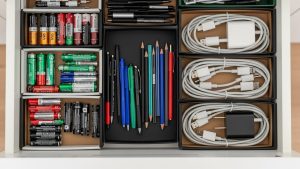
The Box Method: Use small boxes (shoe boxes, iPhone boxes) to compartmentalize drawers. You don’t need to buy expensive acrylic organizers.
-
Kitchen: Keep counters clear. If you use the toaster once a week, put it in a cabinet. Visual noise causes stress.
-
Bathroom: Discard expired makeup and medication. According to the FDA, old eye makeup breeds bacteria that can cause infections.
6. Category 5: Sentimental Items (The Final Boss)
You leave this for last because your “joy sensor” needs to be honed first. Photos, letters, heirlooms. If you try to sort photos first, you will spend 4 hours looking at old vacation snaps and clean nothing.
The Strategy: Do not keep photos in a box in the attic. That is not honoring the memory; that is storing paper. Go through the photos. Keep the ones that truly capture the moment. Put them in an album or frame them. The hard truth: If you inherited a vase from your grandmother that you hate, you are not honoring her by keeping it out of guilt. You honor her by remembering her love, not by hoarding her porcelain. Thank the object, and let it go.

Frequently Asked Questions (FAQs)
Q: What if I regret throwing something away? A: In the vast majority of cases, you won’t. But if you do, consider it a lesson. You can usually replace the item. The cost of replacing one item is worth the peace of mind gained from clearing out thousands of others.
Q: Does this work for families with kids? A: Yes, but don’t force it on them. Lead by example. Clean your stuff first. When your kids see how happy you are with your organized space, they often get curious. For their toys, involve them: “Which toy makes you happiest?” rather than “Throw this away.”
Q: Do I have to do it all at once? A: Marie Kondo suggests a “tidying festival”—doing it quickly (over a weekend or a few weeks) to create a drastic shift in mindset. If you drag it out over a year, clutter will creep back in before you finish.
Q: Can I keep things that are just useful, not joyful? A: Yes. A hammer might not “spark joy,” but a functioning house sparks joy. If a utilitarian tool makes your life easier, keep it with gratitude.
Conclusion
Following the KonMari method checklist is not just about having a tidy home; it is about decision-making. You are practicing the skill of choosing what matters to you and discarding what burdens you. This skill bleeds into your life—your relationships, your job, and your habits. When you finish, you are left with a home filled only with things that support your life and spark joy. And that is the magic.