How to Stop Cats from Scratching Furniture: A Cruelty-Free Guide to Saving Your Sofa
Introduction
Learning how to stop cats from scratching furniture usually begins the moment you hear that distinct rip-rip-rip sound coming from your living room. I remember buying a beautiful mid-century modern armchair in velvet teal. It was the centerpiece of my apartment. Three days after bringing it home, my tabby cat, Luna, decided it was her new personal manicure station. Within a week, the armrest looked like shredded wheat.
I was furious. I thought she was doing it out of spite. I sprayed her with water, I yelled “No!”, and I even tried covering the chair in tin foil (which just made my living room look like a conspiracy theorist’s bunker). Nothing worked. It wasn’t until I consulted a feline behaviorist that I realized I was fighting biology with psychology. Luna wasn’t being bad; she was being a cat.
In this comprehensive 1200-word deep dive, I will explain why your cat is destroying your couch, why declawing is never the answer, and the exact steps on how to stop cats from scratching furniture by giving them something better to sink their claws into.
1. The Biology: Why Do They Do It?
To solve the problem, you have to stop thinking like a human and start thinking like a predator. Scratching is an instinctual behavior, not a behavioral problem. According to the Cornell Feline Health Center, cats scratch for three specific reasons:
-
Maintenance: They need to shed the dead outer layer of their claws (the sheath) to reveal the sharp new claw underneath.
-
Stretching: Have you noticed they stretch their entire body when they scratch? It is like yoga for cats. They engage their shoulders and back muscles.
-
Communication (Scent Marking): This is the big one. Cats have scent glands in their paw pads. When they scratch your sofa, they are leaving a visual mark (shreds) and a chemical mark (scent) that says, “This territory belongs to me.”
Punishing them for this is like punishing a human for blinking. You cannot stop the urge; you can only redirect it.
2. The “No” vs. “Yes” Principle
The biggest mistake owners make is just saying “No.” If you take away their scratching spot (the sofa) without giving them an equally good alternative, they will just move to the curtains or the rug. You must provide a “Yes.”
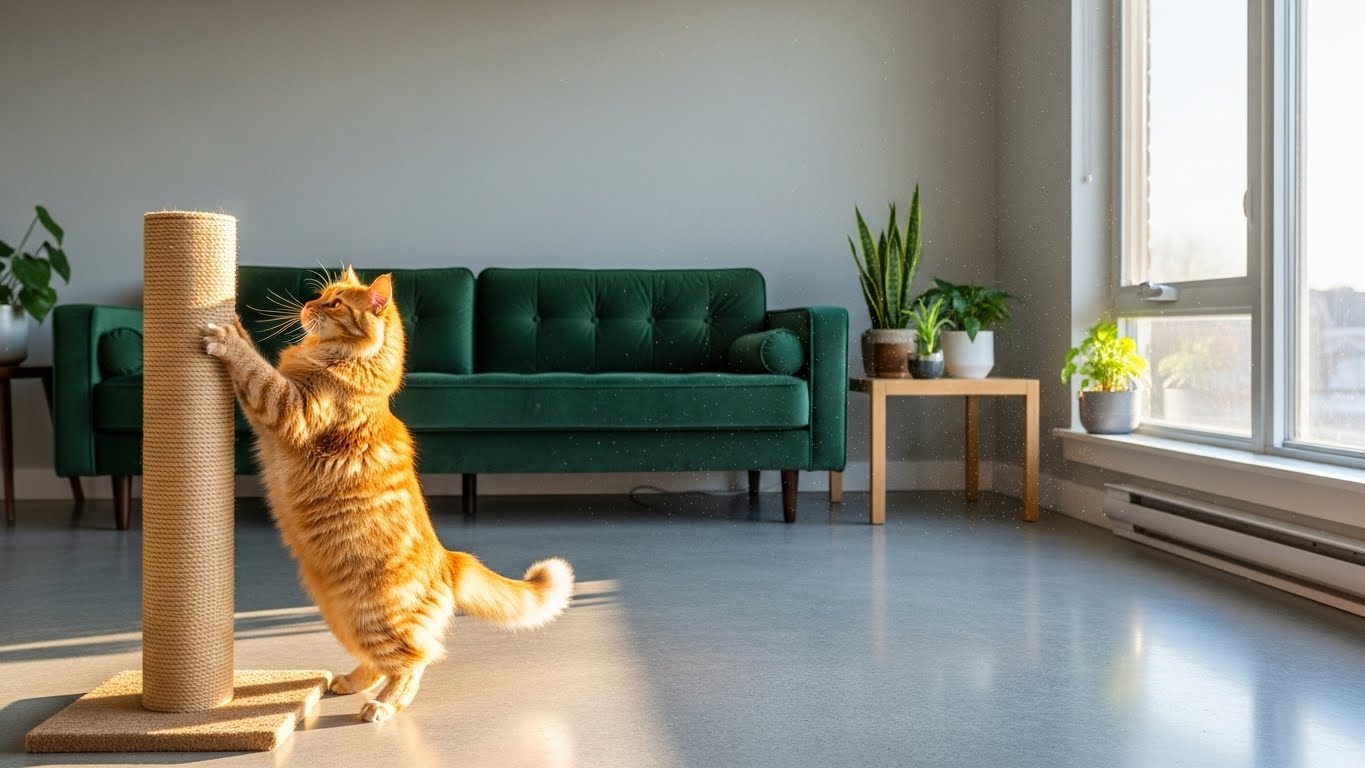
The Golden Rule of Location: Where is your cat scratching? Is it the arm of the sofa where you sit every night? That is not a coincidence. They are mixing their scent with yours. Do not put the scratching post in the basement or a spare room. If you hide the post, they won’t use it. Strategy: Place the new scratching post immediately next to the item they are currently destroying. You want to offer a trade: “Don’t scratch this (sofa), scratch this (post).”
3. Choosing the Right Scratcher: Why They Hate Yours
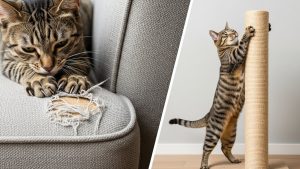
“I bought a scratching post, but she ignores it!” I hear this all the time. Usually, it is because you bought the wrong post. Cats are picky engineers. If the equipment creates a bad user experience, they won’t use it.
The Three Pillars of a Good Post:
-
Height: It must be tall enough for the cat to fully extend their body. Small, dinky posts are useless. Look for at least 32 inches tall.
-
Stability: If the post wobbles when they scratch, they will never touch it again. The sofa doesn’t wobble. Your post shouldn’t either. It needs a heavy base.
-
Material: Most cats prefer Sisal Rope (rough texture). Some like cardboard. Almost no cats like carpet scratchers (because it feels too similar to your rugs, which is confusing).

4. The Deterrent Phase: Making the Sofa Unappealing
While you are training them to use the post, you need to make the sofa temporarily “gross” to touch. You are changing the texture.
-
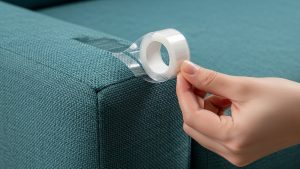
Double-Sided Tape: Cats hate sticky things. Apply specialized furniture tape (like “Sticky Paws”) to the corners of the couch. When they touch it, they get a sticky sensation and back off.
-
Plastic/Vinyl Guards: You can buy clear vinyl sheets that pin onto the upholstery. Claws slide right off plastic.
-
Scent Deterrents: Cats dislike citrus and menthol. However, be careful with essential oils as some (like tea tree) are toxic to cats. Stick to safe, commercial sprays.
Use these deterrents for 2-3 weeks until the habit is broken.
5. Nail Maintenance: The Sharpness Factor
If your cat’s claws are needle-sharp, they do more damage and feel a stronger urge to scratch. Trimming your cat’s nails every 2-3 weeks significantly reduces destruction.
How to Trim Safely:
-
Wait until your cat is sleepy.
-
Gently press the paw pad to extend the claw.
-
Trim only the white tip. Avoid the pink part (the quick), which contains blood vessels and nerves.
-
Give a high-value treat (like Churu or tuna) immediately after.
If you are terrified of cutting the quick, ask your vet to show you how, or use “Soft Paws” (vinyl nail caps) that glue onto the claw. They look like nail polish and prevent scratching damage for 4-6 weeks.

6. The Truth About Declawing (Onychectomy)
I must address this because some people still think declawing is a simple “permanent nail trim.” It is not. Declawing involves amputating the last bone of each toe. It is the equivalent of cutting off a human’s finger at the first knuckle. According to the Humane Society of the United States, declawing can lead to chronic pain, arthritis, and behavioral issues like biting (because they lost their primary defense) and avoiding the litter box (because digging hurts their paws). Many countries and US cities have banned the practice. Please, never declaw. There are always humane alternatives.
Frequently Asked Questions (FAQs)
Q: My cat scratches the carpet, not the sofa. What do I do? A: This means your cat is a “horizontal scratcher.” Vertical posts won’t work. Buy a flat cardboard scratcher or a sisal mat and place it directly over the spot they usually scratch on the rug.
Q: Does Feliway work? A: Feliway is a synthetic pheromone that mimics the “happy cat” scent. It can help reduce stress-scratching, but it won’t stop maintenance scratching. It works best as a support tool, not a magic cure.
Q: Can I train an old cat? A: Absolutely. While kittens learn faster, older cats can be retrained using the same methods. It just takes more patience to break the established habit.
Q: Why does my cat look at me while scratching? A: They aren’t taunting you; they are getting your attention. If you yell, you are giving them attention (even if it’s negative). It’s better to silently pick them up and move them to the post, then praise them when they use it.
Conclusion
Understanding how to stop cats from scratching furniture is about compromise. You value your decor; your cat values their territory. By providing a tall, sturdy sisal post, placing it in a prime location, and making your furniture temporarily sticky, you can coexist peacefully. Remember, your cat isn’t trying to ruin your life—they are just trying to be a cat. Give them a “Yes,” and they will happily leave the sofa alone.