How to Fix Your Sleep Schedule: A Science-Backed Guide to Deep Rest
Introduction
Learning how to fix your sleep schedule is often a desperate Google search made at 3:00 AM while staring at the ceiling, wondering why your brain won’t shut off. I know the feeling well. For years, I was a victim of “Revenge Bedtime Procrastination.” After a long day of work, the night felt like the only time I had for myself. So, I would scroll through TikTok, watch one more episode of Netflix, and suddenly, birds were chirping outside. I was living in a perpetual state of jet lag without ever leaving my time zone.
We treat sleep like a bank account we can overdraft. We think we can “catch up” on weekends. But biology doesn’t work that way. Sleep deprivation destroys your immune system, kills your testosterone, and ruins your focus. The good news is that your body wants to sleep. You just have to speak its language.
In this comprehensive 1200-word deep dive, I will explain the neuroscience of the “Circadian Rhythm,” why your morning coffee is ruining your night, and the exact protocol on how to fix your sleep schedule in less than a week.
1. The Master Clock: Sunlight is the Key
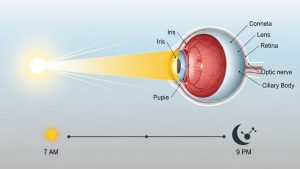
Most people try to fix their sleep by focusing on bedtime. This is backward. To fix your sleep, you must focus on wake-up time. Your brain has a master clock called the Suprachiasmatic Nucleus (SCN). It runs on a 24-hour cycle, and its primary trigger is Light.
The Protocol: Within 30 minutes of waking up, you must get bright sunlight in your eyes.
-
Why: This triggers a cortisol spike (which is good in the morning). It signals to your brain, “The day has started.” This sets a timer. About 12-14 hours later, your brain will automatically release Melatonin (the sleep hormone).
-
How: Go outside. Windows block the specific light spectrum needed. If it’s sunny, 10 minutes is enough. If it’s cloudy, 20 minutes.
If you skip this step and stay in the dark, your clock never starts, and you won’t feel tired until 2 AM. According to the Sleep Foundation, light exposure is the single most powerful tool for entraining your circadian rhythm.
2. The “Caffeine Curfew”: Respect the Half-Life
You might say, “I can drink coffee at dinner and sleep fine.” You might fall asleep, but you are not getting deep sleep. Caffeine works by blocking Adenosine receptors. Adenosine is the molecule that builds up all day to make you feel sleepy (“Sleep Pressure”). When caffeine blocks it, you feel alert.
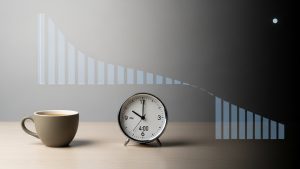
The Half-Life Problem: Caffeine has a half-life of about 5-6 hours. If you drink a double espresso (200mg) at 4:00 PM:
-
At 10:00 PM, you still have 100mg in your system (equal to a cup of coffee).
-
At 4:00 AM, you still have 50mg.
This lingering caffeine prevents your brain from entering deep, restorative Delta-wave sleep. You wake up feeling tired, drink more coffee, and the cycle continues. The Fix: No caffeine after 12:00 PM or 2:00 PM at the latest.
3. Temperature: Cool It Down
Your body needs to drop its core temperature by about 2-3 degrees Fahrenheit to initiate sleep. If your room is hot, your body struggles to cool down, leading to fragmented sleep. This is why you always sleep better in a cold hotel room than a stuffy apartment.
The Ideal Setting: Set your thermostat to around 65°F (18°C). If you don’t have AC, take a warm bath or shower before bed.
-
The Paradox: A warm bath actually cools you down. When you get out of the warm water, your blood vessels dilate (vasodilation), dumping heat from your core to the surface of your skin. This rapid cooling signals the brain that it’s time to sleep.
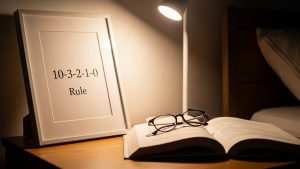
4. The 10-3-2-1-0 Rule: A Perfect Routine
Building a routine is hard, so fitness coach Craig Ballantyne created a numerical formula that is easy to remember. This is the gold standard for sleep hygiene.
-
10 hours before bed: No more caffeine.
-
3 hours before bed: No more food or alcohol. (Digestion raises body temperature and disrupts sleep).
-
2 hours before bed: No more work. Close the laptop. Cortisol needs to drop.
-
1 hour before bed: No more screens (Blue light). Read a physical book.
-
0: The number of times you hit the snooze button in the morning.
Following this structure removes the variables that destroy sleep quality.
5. Melatonin vs. Magnesium: The Supplement Trap
When we can’t sleep, we run to the pharmacy for Melatonin gummies. Stop doing this. Melatonin is a hormone. Taking high doses (5mg or 10mg) every night can downregulate your body’s natural production. It helps you fall asleep, but it often causes grogginess the next day and vivid nightmares.
The Better Alternative: Most people are deficient in Magnesium. Magnesium Bisglycinate or Magnesium Threonate helps relax the muscles and calm the nervous system without messing with your hormones. It acts as a sedative for the body, not just the brain. Disclaimer: Always consult your doctor before starting new supplements.
6. The “NSDR” Hack: What if I Can’t Sleep?
You laid in bed, phone away, room cool, but you are still wide awake. Anxiety sets in. “If I don’t sleep now, I’ll be tired tomorrow.” This anxiety keeps you awake.
The Solution: Non-Sleep Deep Rest (NSDR) or Yoga Nidra. This is a guided relaxation technique (you can find free videos on YouTube, search for “Huberman NSDR”). It guides you through a body scan, slowing down your heart rate and brain waves. Even if you don’t fall asleep, 20 minutes of NSDR provides mental restoration similar to a nap. It removes the pressure to sleep, which ironically helps you fall asleep faster.
7. Weekend Consistency: The “Social Jetlag”
Here is where everyone fails. You follow the rules Monday to Friday, waking up at 7 AM. On Friday night, you stay up until 2 AM and sleep until 11 AM on Saturday. Congratulations, you just gave yourself jet lag equivalent to flying from New York to London. Come Sunday night, your body isn’t tired at 10 PM because it thinks it is 6 PM.
The Fix: You must wake up at the same time every day, even on weekends. Ideally within a 30-minute window. If you stay up late, still wake up at your normal time and take a 20-minute nap later. Do not sleep in.

Frequently Asked Questions (FAQs)
Q: Does blue light really matter? A: Yes. Blue light (from phones and LEDs) mimics the sun. It hits the melanopsin receptors in your eyes and suppresses melatonin production. Use “Night Shift” mode or wear blue-light blocking glasses if you must use screens.
Q: Can I exercise at night? A: Intense cardio raises body temperature and cortisol, making sleep hard. Try to finish heavy workouts 3 hours before bed. Yoga or stretching is fine.
Q: What about napping? A: Napping is a tool. Keep it under 20 minutes (power nap) or complete a full 90-minute cycle. Anything in between (30-60 mins) leads to “Sleep Inertia” (grogginess).
Q: Why do I wake up at 3 AM? A: This is often a blood sugar crash or a cortisol spike. Eating a small amount of protein/fat (like almond butter) before bed might stabilize blood sugar. Or it could be alcohol—alcohol puts you to sleep but wakes you up when it wears off.
Conclusion
Figuring out how to fix your sleep schedule is not about willpower; it is about biology. You cannot fight your own hormones and win. By controlling light, temperature, and timing, you align your lifestyle with your ancestral wiring. The result isn’t just better sleep; it is a better life. You wake up ready to attack the day, not just survive it. Tonight, put the phone down, dim the lights, and let your body do what it was designed to do.