
How to Potty Train a Puppy Fast: A No-Fail Schedule for Busy Owners
Introduction
Figuring out how to potty train a puppy fast is usually the first desperate Google search a new owner makes at 3:00 AM while standing over a puddle on their expensive rug. I’ve been there. When I brought home my Golden Retriever puppy, Barnaby, I thought I was prepared. I had the toys, the food, and the bed. But within 24 hours, my apartment smelled like a kennel, and I was exhausted. I thought he was being stubborn. In reality, he was just a baby with zero bladder control.
Potty training is not about luck; it is about biology and consistency. A puppy physically cannot hold their bladder for long periods. If you don’t have a schedule, you are setting them up to fail. In this comprehensive 1200-word deep dive, I will share the exact “1-Hour Rule,” explain why punishment never works, and provide a step-by-step guide on how to potty train a puppy fast using positive reinforcement and crate training.
1. The Biology: The “Month-Plus-One” Rule
Before we start training, we must understand the hardware. A puppy’s bladder is tiny. The muscles required to “hold it” are not fully developed until they are about 4-6 months old. According to the American Kennel Club (AKC), a general rule of thumb for holding urine is: Age in Months + 1 = Hours.
-
2 Months old: Can hold it for 3 hours max.
-
3 Months old: Can hold it for 4 hours.
This applies to sleeping hours. When they are awake and playing, their metabolism speeds up, and they might need to go every 30 minutes. If you expect an 8-week-old puppy to hold it for an 8-hour work day, you are fighting biology.
2. The Crate: Your Secret Weapon
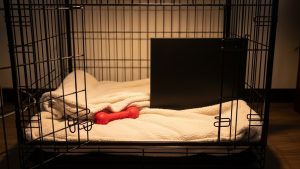
Many new owners feel guilty about using a crate. They think it’s a cage. But to a dog, a crate is a Den. Dogs are den animals; they have a natural instinct not to soil where they sleep. This instinct is the key to how to potty train a puppy fast.
The Strategy:
-
Buy a crate with a divider. Make the space just big enough for the puppy to stand up, turn around, and lie down.
-
If the crate is too big, they will pee in one corner and sleep in the other.
-
When you cannot supervise your puppy with 100% focus, they go in the crate (for short periods). This prevents accidents and teaches them to hold it until you let them out.
3. The Schedule: Consistency is King
Dogs thrive on routine. If you feed them at different times, they will poop at different times. To predict their bathroom habits, you must control the input.
The “No-Fail” Daily Routine:
-
Morning: Wake up and immediately carry them outside. Do not let them walk (they might pee on the way).
-
Breakfast: Feed them. Puppies usually need to poop 15-30 minutes after eating due to the “Gastrocolic Reflex.”
-
Play: Take them out after play sessions. Excitement stimulates the bladder.
-
Nap: Take them out immediately after they wake up from a nap.
-
Bedtime: Remove water 2 hours before bed to minimize night accidents.

4. The “Go” Spot and The Command
Don’t just stand in the yard silently scrolling on your phone. You are the coach. Pick one specific spot in the yard. Urine leaves a scent marker. When you take them to that spot, the scent triggers the urge to go.
The Cue: As soon as they start squatting, say your cue word (“Go Potty,” “Do Business”). The Reward: The second they finish (not before!), throw a party. Give them a high-value treat (chicken, liver) and praise them like they just won the lottery. According to the Humane Society, this positive reinforcement makes the puppy want to pee outside because that’s where the chicken happens.
5. Dealing with Accidents: The Enzymatic Solution
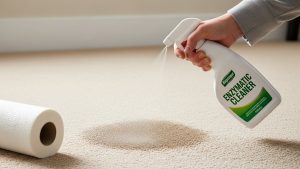
You will have accidents. It is inevitable. The biggest mistake owners make is cleaning it with regular household cleaners (ammonia or bleach). The Science: Urine contains uric acid crystals. Regular cleaners mask the smell to humans, but to a dog’s sensitive nose, it still smells like a toilet. Ammonia actually smells like urine to a dog, encouraging them to pee there again.
The Fix: You must use an Enzymatic Cleaner (like Nature’s Miracle). These cleaners contain bacteria that eat the uric acid crystals, completely removing the scent marker. If you don’t destroy the scent, your puppy will return to the scene of the crime forever.
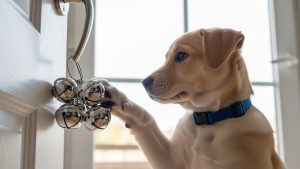
6. Bell Training: Giving Them a Voice
How does your puppy tell you they need to go? They might stare at you, whine, or scratch the door. But if you are in the kitchen, you miss the signal. Bell Training bridges this gap.
-
Hang a set of “Poochie Bells” on the doorknob.
-
Every time you take them out, tap the bell with their nose or paw and say “Outside.”
-
Open the door immediately.
-
Within 1-2 weeks, your puppy will learn: Ring Bell = Door Opens.
This empowers the puppy to communicate with you from another room.
7. Punishment: Why Rubbing Their Nose is Wrong
Old school advice said to rub a dog’s nose in their mess. Do not do this. Dogs live in the moment. If you find a puddle 10 minutes after they made it and yell at them, they have no idea why you are angry. They just think you are scary and unpredictable. This leads to “submissive urination” (peeing out of fear) or hiding behind the sofa to poop so you don’t see them. If you catch them in the act, make a sharp noise (“Ah-Ah!”), pick them up immediately (this usually stops the flow), and run outside. Finish there and praise.
Frequently Asked Questions (FAQs)
Q: What about Puppy Pads? A: Use them with caution. Pads teach a dog that it is okay to pee on soft, square surfaces inside the house. This often translates to peeing on your bath mat or area rug later. If you have a yard, skip the pads and go straight to outdoor training.
Q: How do I handle apartment living? A: If you are on the 10th floor, you can’t run outside in time. Use a “Fresh Patch” (real grass in a box) on your balcony. It feels and smells like grass, making the transition to outdoors easier than paper pads.
Q: My puppy pees when excited. Why? A: This is “Excitement Urination.” It’s common in puppies. They lose muscle control when happy. Don’t scold them. Greet them calmly outside to avoid accidents.
Q: Regression: He was trained, now he’s not! A: Around 6-10 months (adolescence), dogs often regress. Their brain is rewiring. Go back to basics. Re-introduce the crate and the strict schedule for two weeks.
Conclusion
Learning how to potty train a puppy fast is a test of patience, not intelligence. Your puppy wants to please you; they just need to learn the language. By using a crate to prevent mistakes, a schedule to predict success, and high-value treats to reward it, you can have a fully house-trained dog in a matter of weeks. Take a deep breath, buy the enzymatic cleaner, and remember: this phase is temporary, but the bond you build is permanent.