How to Reduce Food Waste at Home: A Guide to Saving Money and the Planet
Introduction
Learning how to reduce food waste usually starts with a guilt trip. We have all been there: You open the crisper drawer in your fridge, hoping to make a healthy salad, only to find a bag of slimy, liquefied spinach that you bought with good intentions five days ago. You sigh, throw the plastic bag in the trash, and order a pizza.
It feels like a small failure, but it adds up. According to the USDA, between 30-40% of the food supply in the United States is wasted. That is billions of pounds of food going into landfills, where it rots and produces methane—a greenhouse gas far more potent than carbon dioxide. But beyond the environmental impact, there is the financial one. The average family of four loses about $1,500 a year on wasted food. Imagine taking $1,500 cash and setting it on fire. That is effectively what we are doing.
In this comprehensive 1200-word deep dive, I will decode the confusing world of expiration dates, teach you the science of food storage (Ethylene gas is the enemy), and share actionable hacks on how to reduce food waste so you can stop throwing your money in the bin.
1. The Label Lie: “Best By” vs. “Use By”
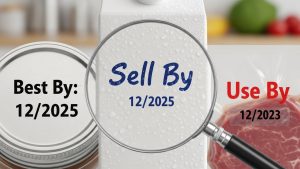
The biggest cause of food waste is confusion over date labels. We see a date, it passes, and we assume the food is poison. Here is the truth: With the exception of baby formula, federal regulations do not require date labels on food. They are voluntary markers set by manufacturers.
-
“Best If Used By/Before”: This is about Quality, not safety. The chips might be slightly less crunchy, or the salsa slightly less spicy after this date, but it is safe to eat.
-
“Sell By”: This is for the store staff, not you. It tells them when to rotate stock. You can buy it on this date and eat it days later.
-
“Use By”: This is the only one to watch closely, usually found on meat and dairy. It indicates the last date recommended for peak quality, and for perishables, safety.
The Sniff Test: Your nose is a sophisticated evolutionary tool. If milk smells sour, toss it. If it smells fine, it’s fine, even if the date was yesterday. Trust your senses over the stamp.
2. The Science of Storage: Controlling Ethylene Gas
Have you ever noticed that if you put a banana next to an avocado, the avocado ripens overnight? That is because of Ethylene Gas. Some fruits are “Ethylene Producers” (Bananas, Apples, Tomatoes), and some are “Ethylene Sensitive” (Leafy Greens, Carrots, Cucumbers). If you store them together, the gas from the apple will cause the lettuce to rot prematurely.
The Strategy:
-
Keep them separated: Store apples and bananas in a bowl on the counter, away from other produce.
-
The Fridge Zones: Keep ethylene-sensitive veggies in the high-humidity drawer of your fridge, far away from fruit.
3. Herb and Veggie Hacks: The “Bouquet” Method
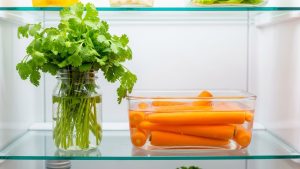
Leafy herbs (Cilantro, Parsley) and Asparagus act like flowers. If you toss them in a plastic bag, they slime up. The Fix: Trim the stems and place them upright in a jar of water (like a bouquet of flowers). Cover loosely with a plastic bag and store in the fridge. They will stay crisp for 2-3 weeks instead of 3 days.
The Carrot Bath: Carrots and celery go limp because they lose moisture (dehydration). Chop them up and store them in a glass container submerged in cold water. Change the water every few days. They will stay crunchy for a month.
4. Fridge Organization: FIFO (First In, First Out)
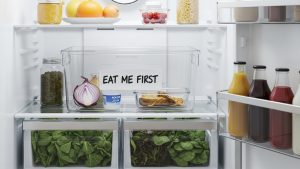
Grocery stores use the FIFO method to rotate stock. You should too. When you buy new yogurt, put it at the back of the shelf and move the old yogurt to the front. The “Eat Me First” Box: Place a dedicated bin in your fridge labeled “Eat Me First.” Put anything that is about to expire (half an onion, a lonely zucchini, leftovers) in this box. When you are hungry for a snack or planning dinner, look in this box first. This simple visual cue prevents items from getting lost in the back of the fridge abyss.
5. The Magic of the Freezer: Pause Buttons
The freezer is not a graveyard; it is a pause button. Almost anything can be frozen if you are about to lose it.
-
Bread: Slice it and freeze it. Toast it directly from frozen. It tastes fresh every time.
-
Berries: If they are getting mushy, freeze them for smoothies.
-
Milk: Yes, you can freeze milk (pour a little out first as it expands).
-
Tomato Paste: Freeze leftover paste in an ice cube tray. Pop out a cube whenever a recipe calls for a tablespoon.
6. Cooking with Scraps: The “Zero Waste” Broth
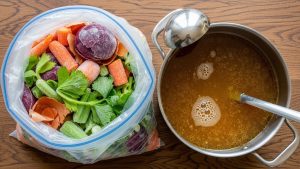
Most of what we throw away is flavor gold. Onion skins, carrot tops, celery ends, and mushroom stems—these are usually tossed in the compost (or trash). The Broth Bag: Keep a large Ziploc bag in your freezer. Every time you chop veggies, throw the clean scraps into the bag. When the bag is full:
-
Dump contents into a pot.
-
Cover with water.
-
Simmer for 2 hours.
-
Strain. You now have free, rich, homemade vegetable stock for soups and risottos.
7. Meal Planning: Shop Your Pantry First
We often go grocery shopping without looking at what we already have. We buy rice when we have three bags at home. The Reverse Shopping List: Before you leave the house, verify what you have. Plan meals around those ingredients. “I have a can of chickpeas and some frozen spinach. Okay, I’ll make a curry. I just need coconut milk.” This prevents over-buying and forces you to use up the older items in your pantry.
Frequently Asked Questions (FAQs)
Q: Is it safe to cut mold off cheese? A: It depends. For Hard Cheeses (Cheddar, Parmesan), yes. The mold roots can’t penetrate deep. Cut 1 inch around the mold and eat the rest. For Soft Cheeses (Brie, Ricotta) or bread, no. The mold roots go deep. Toss the whole thing.
Q: Can I eat eggs after the expiration date? A: Usually, yes. Do the Float Test. Put the egg in a bowl of water. If it sinks, it’s fresh. If it floats, it has developed gas inside (rotting) and should be tossed.
Q: How do I store bread? A: Never in the fridge! The cold temperature creates a reaction called retrogradation that makes bread go stale faster. Store it on the counter (in a box) or in the freezer.
Q: What about wilted lettuce? A: It’s just dehydrated. Soak it in a bowl of ice water for 20 minutes. The cells will re-absorb the water, and it will crunch up again.
Conclusion
Mastering how to reduce food waste is a mindset shift from abundance to appreciation. It honors the resources—the water, the labor, the transport—that went into producing your food. By learning to store carrots in water, ignoring arbitrary dates, and turning scraps into soup, you become a smarter cook and a better steward of the planet. Plus, finding an extra $1,500 in your budget at the end of the year isn’t bad either.