
How to Fix Tech Neck: 5 Exercises to Reverse Poor Posture Forever
Introduction
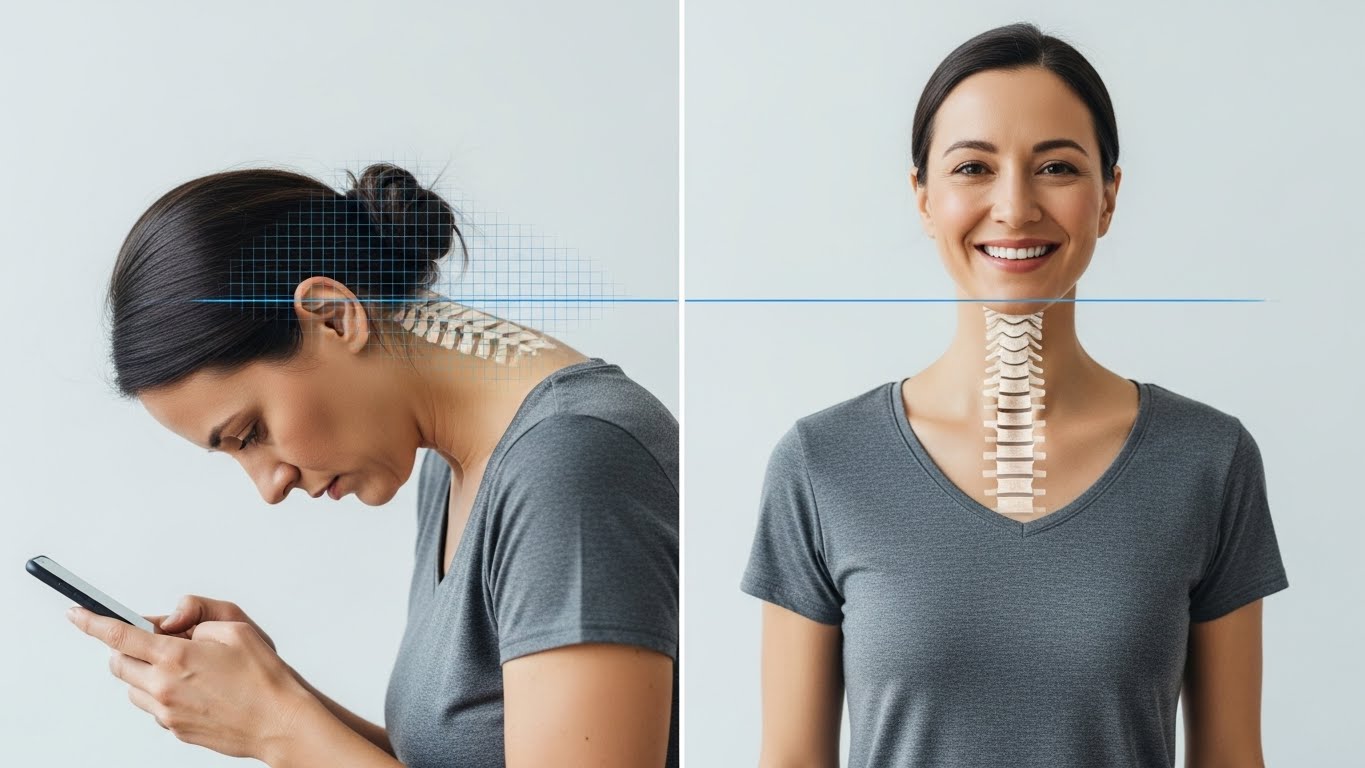
Learning how to fix tech neck usually becomes a priority the moment you catch a glimpse of your side profile in a mirror and realize you look like a question mark. Or maybe it starts with the chronic headaches at the base of your skull that Tylenol just won’t touch. I remember the day I decided to change. I saw a photo of myself sitting at my laptop, and my head was jutting forward like a turtle coming out of its shell. My shoulders were rounded so far forward they were practically touching my chest.
We live in a world designed to make us hunch. We drive hunched, we type hunched, and we scroll through TikTok hunched. But this isn’t just an aesthetic issue; it’s a structural one. “Tech Neck” (or Forward Head Posture) is causing a silent epidemic of cervical spine degeneration in people as young as 20.
In this comprehensive 1200-word deep dive, I will explain the terrifying physics of head weight, debunk the “posture brace” scam, and teach you the exact daily routine on how to fix tech neck and reclaim your height and confidence.
1. The Physics: Why Your Head Weighs 60 Pounds
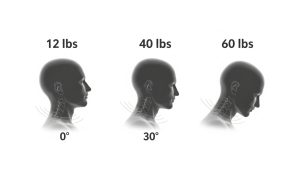
Your head weighs about 10-12 pounds (like a bowling ball). When your ears are aligned over your shoulders, your spine handles this weight effortlessly. However, for every inch your head moves forward, the weight on your neck adds an additional 10 pounds of leverage.
According to a famous study published in Surgical Technology International, looking down at your phone at a 60-degree angle puts 60 pounds of force on your cervical spine. Imagine carrying an 8-year-old child around your neck for 4 hours a day. That is what you are doing to your vertebrae. This constant pressure leads to disc herniation, pinched nerves, and the dreaded “Dowager’s Hump” (fatty pad) at the base of the neck.
2. The “Chin Tuck”: The Anti-Venom Exercise
If looking down is the poison, the Chin Tuck is the antidote. This is the single most effective exercise for resetting head position. It strengthens the deep cervical flexors (the muscles in the front of your neck that get weak) and stretches the suboccipital muscles (the muscles at the base of your skull that get tight).
How to do it:
-
Sit up tall.
-
Place two fingers on your chin.
-
Gently push your chin straight back (horizontally), as if you are trying to make a “double chin.”
-
Do NOT look down. Keep your eyes level.
-
Hold for 5 seconds. You should feel a deep stretch at the base of your skull.
-
Repeat 10 times.
Do this in the car (press your head against the headrest) or at your desk every hour.

3. Open the Doorway: Stretching the Pecs
Why do our shoulders round forward? Because our chest muscles (Pectorals) are tight from typing. When your Pecs are tight, they pull your shoulders forward internally. You cannot force your shoulders back if your chest is pulling them forward. You must stretch the front first.
The Doorway Stretch:
-
Stand in an open doorway.
-
Place your forearms on the doorframe at a 90-degree angle (cactus arms).
-
Step one foot through the doorway and lean forward until you feel a stretch in your chest.
-
Hold for 30 seconds.
This physically opens the thoracic cavity and allows your shoulders to drop back into their natural sockets without effort.
4. Thoracic Extension: Un-Hunching the Upper Back
Tech neck isn’t just a neck problem; it’s an upper back problem. Your Thoracic Spine (upper back) gets stuck in a C-shape (Kyphosis). You need to mobilize it.
The Foam Roller Extension:
-
Lie on the floor with a foam roller horizontally under your upper back (shoulder blades).
-
Support your head with your hands (interlace fingers behind neck).
-
Gently lean backward over the roller, extending your spine.
-
Do not roll the lower back. Focus only on the upper back.
-
You might hear a few satisfying cracks. That is your spine mobilizing.

5. Ergonomics: Raise Your Screens
You can do all the exercises in the world, but if you go back to staring down at a laptop for 8 hours, nothing will change. You must change your environment.
The Rules:
-
Eye Level: The top 1/3 of your monitor must be at eye level. Use a laptop stand or a stack of books. If you are looking down, it’s wrong.
-
Elbows: Your elbows should be at 90 degrees. If your keyboard is too high, your shoulders will creep up to your ears (shrugging).
-
The Phone: Stop holding your phone at your belly button. Hold it up in front of your face. Yes, it looks silly. Yes, your friends will laugh. But your spine will thank you.
6. The “Posture Brace” Myth
You see ads for them on Instagram—straps that forcefully pull your shoulders back. Don’t buy them. According to physical therapists, posture braces create muscle atrophy. Because the brace does the work of holding you up, your actual postural muscles get lazy and weaker. When you take the brace off, your posture will be worse than before. You want to train your muscles, not replace them. Active effort beats passive support every time.
7. Sleeping Position: The Pillow Factor
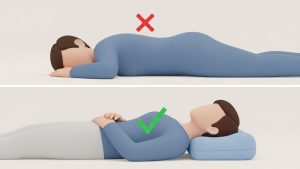
You spend 8 hours a night in one position. If you sleep on your stomach, you are twisting your neck for 8 hours. This is terrible for Tech Neck. Best Position: Back sleeping with a thin pillow, or side sleeping with a pillow that fills the gap between your ear and the mattress. Invest in a contoured cervical pillow that supports the natural curve of your neck. It’s a $40 investment that pays off every single morning.
Frequently Asked Questions (FAQs)
Q: How long does it take to fix? A: It took years to develop the problem, so it won’t be fixed in a day. However, most people feel pain relief within 1 week of doing Chin Tucks. Visible posture changes usually take 4-6 weeks of consistent exercise.
Q: Can I fix the “hump” on the back of my neck? A: Yes. That hump (often called a Dowager’s Hump) is partly fatty tissue and partly prominent vertebrae sticking out due to the forward angle. By correcting the head posture, the vertebrae retreat, and the hump becomes significantly less visible over time.
Q: Does standing desk help? A: Yes, but only if the monitor height is correct. Standing while looking down at a laptop is just as bad as sitting while looking down.
Q: Is chiropractic safe for this? A: Adjustments can provide temporary relief, but without the muscle strengthening exercises (like Chin Tucks), the bones will just slide back into the bad position. Muscle holds bone.
Conclusion
Mastering how to fix tech neck is a battle against gravity and modern technology. It requires mindfulness. You have to catch yourself slouching 50 times a day and correct it 50 times a day. But the reward is immense. Good posture projects confidence, reduces pain, and actually helps you breathe deeper (by opening the chest). So, right now, as you read this sentence: Chin back, shoulders down, chest up. There. You just started.